
Banners look simple until you have to order one.
Vinyl or fabric? Grommets or pole pockets? Indoor or outdoor? And then the material question that trips up almost every first-time buyer: what is the difference between mesh and standard vinyl, and why does it matter for a banner that is going on a fence?
Banner printing is not one product. It is a category with four distinct material types, each built for a different environment, installation method, and lifespan. Picking the wrong one does not just waste budget, it means the piece fails in the field before the campaign is over.
This guide breaks down each type, what it is made for, and exactly when to use it.
Table of Contents
1. What Is Banner Printing? A Quick Primer
2. Vinyl Banners: When Durability Comes First
3. Mesh Banners: Built for Wind and Outdoor Exposure
4. Fabric Banners: The Trade Show and Indoor Standard
5. Retractable Banners: Portable and Ready When You Are
6. Which Banner Type Should You Choose? A Quick Decision Guide
7. Why NextPage for Banner Printing Services
1. What Is Banner Printing? A Quick Primer
Banner printing is the large format production of flexible printed graphics, typically on vinyl, mesh, or fabric substrates, used for indoor signage, outdoor advertising, event displays, trade show booths, storefronts, and promotions.
What separates banner printing from standard poster or sign printing is the substrate and the finishing. Banners are produced on flexible materials that can be hemmed, grommeted, fitted with pole pockets, or mounted to frames. The finishing method determines how the banner is installed, how long it lasts, and whether it can survive the environment it is going into.
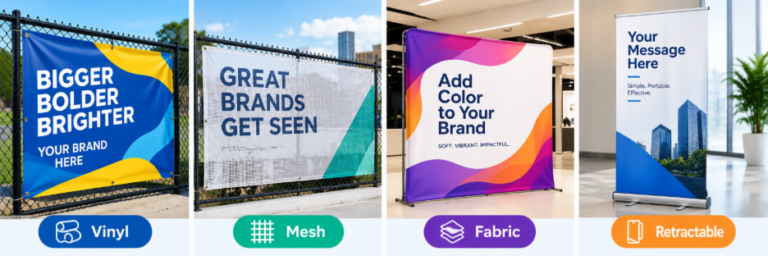
The four main banner types are vinyl, mesh, fabric, and retractable. Each uses a different substrate, different printing process, and different finishing options. Understanding what each one is built for is the starting point for any banner printing services decision.
2. Vinyl Banners: When Durability Comes First
Vinyl is the workhorse of banner printing. It is a PVC-based substrate that is waterproof, tear-resistant, and capable of holding sharp, vibrant color in outdoor conditions for extended periods. Most standard outdoor banners are vinyl.
How It Is Printed
Vinyl banners are typically produced using solvent or UV printing, both of which produce inks that bond deeply to the substrate and resist fading under UV exposure. The result is a piece that holds color outdoors over months, not weeks.
Finishing Options
Standard vinyl banners are finished with hemmed edges and grommets for hanging, or pole pockets for horizontal or vertical rod installation. For heavyweight applications or banners in high-traffic areas, double-sided tape or welded seams add structural reinforcement.
When to Use Vinyl
- Outdoor events, storefronts, and promotions where the banner will be exposed to weather over a period of weeks or months.
- High-visibility street-level signage where color vibrancy and sharp detail are priorities.
- Reusable campaign banners that need to travel between locations and survive repeated installation and removal.
Vinyl is not the right choice for high-wind environments. A solid vinyl banner acts like a sail in sustained wind, putting stress on the grommets and structure it is mounted to. That is where mesh comes in.
Get a Custom Banner Printing Quote from NextPage →
3. Mesh Banners: Built for Wind and Outdoor Exposure
Mesh is a perforated vinyl substrate. It looks similar to standard vinyl from a distance, but the material contains thousands of tiny holes that allow air to pass through. That single difference makes mesh the correct choice for any outdoor installation where wind load is a factor.
How It Is Printed
Mesh banners are printed using solvent or UV inks, the same processes used for standard vinyl. The perforation is built into the substrate before printing, not added after. Ink is applied across the surface, including over the perforations, producing a graphic that reads cleanly from viewing distance despite the physical holes in the material.
When to Use Mesh
- Building wraps and scaffolding: Large-scale outdoor installations where wind resistance is essential to prevent structural damage.
- Fence banners: Construction site fencing, event perimeter fencing, and sports venue barriers where air movement through the material reduces stress on the attachment points.
- Outdoor environments with sustained wind: Rooftop installations, open-air venues, and any location where a solid substrate would create unacceptable wind load.
The trade-off with mesh is resolution. Because the substrate is perforated, fine detail and very small text are less crisp than on solid vinyl. For large graphics viewed from a distance, this is not a visible issue. For close-up signage with small copy, vinyl or fabric is a better choice.
4. Fabric Banners: The Trade Show and Indoor Standard
Fabric banners are produced on woven textile substrates, typically polyester, and printed using dye-sublimation, a process in which heat transfers ink directly into the fabric fibers rather than sitting on the surface. The result is a softer, premium-looking piece with excellent color depth and no surface glare.
How It Is Printed
Dye-sublimation printing produces colors that are part of the fabric itself, not a layer on top of it. This means fabric banners do not scratch, peel, or crack the way surface-printed vinyl can over time. The finish is matte by default, which reduces glare under event lighting, making fabric the preferred substrate for trade show displays and indoor brand installations.
When to Use Fabric
- Trade show booths and backdrops: Fabric tension displays, retractable fabric banners, and step-and-repeat backdrops where a premium, wrinkle-resistant finish is expected.
- Indoor brand installations: Lobby displays, office environments, and retail interiors where the tactile quality of the material matters as much as the graphic.
- Portable event displays: Fabric is lightweight relative to its surface area, making it practical for displays that are packed, transported, and set up repeatedly.
Fabric is not suited for long-term outdoor exposure. Dye-sublimation inks are not UV-resistant in the way solvent inks on vinyl are, and the textile substrate absorbs moisture, which affects both the material and the color over time.
Talk to NextPage About the Right Banner Material for Your Project →
5. Retractable Banners: Portable and Ready When You Are
A retractable banner is not a substrate type, it is a display system. The banner itself is typically printed on a polypropylene or vinyl film substrate, housed in an aluminum base unit, and pulled up and locked into position using a support pole. The entire system rolls back into the base for transport and storage.
How They Work
The banner film is attached to a spring-loaded mechanism inside the base. When deployed, the banner is pulled up, and a support rod locks it in place vertically. Setup takes under two minutes with no tools. When the event is done, the support rod is removed and the banner retracts back into the base automatically.
When to Use Retractable Banners
- Trade shows and conferences: The most common application. Retractable banners are a standard part of any trade show booth because they are portable, fast to set up, and produce a clean professional presentation.
- Retail and point-of-sale: Promotional messaging at checkout, product launch displays, and seasonal signage that needs to change frequently.
- Corporate events and presentations: Speaker backdrops, registration areas, and branded event environments where portability and quick deployment matter.
Retractable banners are an indoor-only format. The base units are not designed for outdoor use and the banner film is not weather-resistant. For outdoor portable displays, a different mounting system with a vinyl or mesh substrate is the correct approach. For indoor large format banner printing that moves between venues, retractable is the most practical solution available.
6. Which Banner Type Should You Choose? A Quick Decision Guide
Here is how the four custom banner printing options compare across the factors that matter most:
| Factor | Vinyl | Mesh | Fabric | Retractable |
| Best environment | Indoor and outdoor | Outdoor, high wind | Indoor only | Indoor only |
| Durability | High: months outdoors | High: wind-resistant | Medium: indoor use | Medium: with care |
| Color quality | Vibrant, sharp | Good from distance | Excellent, matte finish | Good to excellent |
| Portability | Low: requires hardware | Low: requires hardware | Medium: lightweight | High: self-contained |
| Setup | Grommets or pole pockets | Grommets or cable ties | Frame or tension system | Under 2 minutes |
| Best use | Events, storefronts, campaigns | Fences, building wraps | Trade shows, lobbies | Trade shows, retail, events |
| Reusability | High | Medium | High | High |
If the banner is going outside in wind, use mesh. If it is going to a trade show and needs to travel, use fabric or retractable. If it is a high-visibility outdoor campaign piece that will hang in one location for weeks, vinyl is the right call.
7. Why NextPage for Banner Printing Services
NextPage is a Kansas City large format printing provider delivering banner printing services for events, retail, healthcare, corporate, and agency clients across the region and nationally.
- All four banner types: Vinyl, mesh, fabric, and retractable, produced in-house.
- Material guidance included: NextPage recommends the right substrate before production begins.
- 99% on-time delivery: Across 100+ major event partners supported annually.
- Installation support: Hardware, templates, or full on-site coordination for complex installations.
- Fast turnaround: Tight event deadlines met without compromising quality.
Request a Banner Printing Quote from NextPage →
8. Frequently Asked Questions
What is the difference between vinyl and mesh banner printing?
Vinyl is solid and weatherproof — right for most outdoor banners. Mesh has thousands of tiny perforations that let air pass through, making it the correct call for fences, building wraps, and anywhere sustained wind would put stress on a solid banner.
What is a retractable banner and when should I use one?
A retractable banner is a self-contained display — the printed film pulls up from an aluminum base and locks into place with a support pole. Setup takes under two minutes. It is an indoor format, built for trade shows, conferences, and retail displays where you need something portable and professional.
What is the best banner material for outdoor use?
Vinyl for standard outdoor use — waterproof, UV-resistant, and built to last months outdoors. If the location gets sustained wind, switch to mesh. A solid vinyl banner in high wind acts like a sail and puts serious stress on whatever it is attached to.
Can I use fabric banners outdoors?
No. Fabric banners are printed with dye-sublimation inks that are not UV-resistant, and the textile substrate absorbs moisture. Take a fabric banner outside and the material and color both suffer quickly. Fabric is an indoor-only substrate.
What does custom banner printing include?
Custom banner printing covers substrate selection, file prep and artwork review, printing, and finishing. Finishing options — grommets, hemming, pole pockets, lamination — depend on the banner type and how it is being installed. NextPage walks through all of this before production begins.