
Key Takeaways
- Direct mail printing achieves response rates of 5-9% for house lists, significantly higher than email or digital channels (Data and Marketing Association).
- Format, size, and substrate decisions made before design begins directly affect postage cost, deliverability, and response.
- CASS-certified address standardization and presorting are not optional — they are what qualify a campaign for USPS automation pricing.
- Personalization beyond the name drives measurably stronger response than generic creative.
- Post-campaign reporting on deliverability and response is what makes each campaign smarter than the last.
Table of Contents
1. Importance of Direct Mail Printing in 2026
2. Planning Your Direct Mail Campaign
4. Printing Your Direct Mail Campaign
5. Mailing: USPS Optimization and Delivery
6. Direct Mail Campaign at a Glance
7. Why NextPage for Direct Mail Printing Services
1. Importance of Direct Mail Printing in 2026
Digital marketing has more channels than ever. It also has more competition, more noise, and more fatigue. The average person sees hundreds of digital ads every day. Most register nothing.
Direct mail printing lands in a different environment entirely. The physical mailbox is less crowded than the inbox, the format demands engagement before it can be ignored, and the response rates reflect it. The Data and Marketing Association reports direct mail response rates of 5-9% for house lists — figures that most digital channels cannot approach.
The 2026 reality is that direct mail and digital work better together than either works alone. Campaigns that combine personalized direct mail with IP targeting and digital retargeting consistently outperform single-channel programs. Habitat for Humanity of Kansas City saw a 270% lift in conversions when NextPage combined direct mail printing with IP targeting — making it their highest-grossing appeal campaign ever.
The channel is not competing with digital. It is completing it.
2. Planning Your Direct Mail Campaign
Every decision made in planning directly affects what the campaign costs, how it performs, and whether it qualifies for USPS automation pricing. Planning is not a preamble to the real work — it is the real work.
Define the Audience and Objective
A direct mail campaign without a defined audience is a broadcast, not a campaign. Before format or creative is discussed, the audience needs to be segmented by the data that makes them a qualified recipient: giving history, account type, purchase recency, or geography. The objective — acquisition, retention, reactivation, event response — determines the format, the offer, and the call to action.
Choose the Format
Format affects postage rate, production cost, and how the recipient physically interacts with the piece. Postcards reach the lowest USPS postage tier for standard sizes and require no envelope to open. Self-mailers offer more copy space at a lower cost than letter packages. Letter and envelope packages produce the highest response rates of the traditional formats. Dimensional mail has the highest open rates of any format but does not qualify for automation pricing.
Set the List
A direct mail campaign is only as strong as its list. Addresses need to be CASS-certified before production begins. Running the list through USPS National Change of Address (NCOA) removes records for recipients who have moved. Duplicate records mean duplicate postage — remove them before submission.
Talk to NextPage About Planning Your Campaign →
3. Designing for Direct Mail
Direct mail design is not the same as general graphic design. The piece has to perform within USPS technical requirements, survive automated processing at high speed through automated equipment, and make its offer clear within the first two seconds of handling.
Design Rules That Affect Postage
The aspect ratio rule is the most commonly missed: divide the length of the piece by its height. If the result is below 1.3 or above 2.5, the piece is classified as non-machinable and incurs a surcharge of approximately $0.15 to $0.30 per piece, depending on current USPS rates. For a 10,000-piece run, that can add up to significant avoidable cost across the run — all from a size decision made before the first design file was opened.
What to Put on the Front Panel
The offer, not the brand, should be the dominant visual element on the front panel. The headline should tell the recipient what they get, not who sent it. The call to action should be singular — multiple CTAs dilute response. If the piece has a QR code or personalized URL, it needs to be built into the original design, not added as an afterthought after approval.
File Specs for Production
- Resolution: 300 DPI at full output size.
- Color mode: CMYK. RGB files shift color at the RIP stage.
- Bleed: Minimum 0.125 inches on all edges.
- Fonts: All outlined or embedded.
- Address panel: Clear of artwork, positioned to USPS specifications.
4. Printing Your Direct Mail Campaign
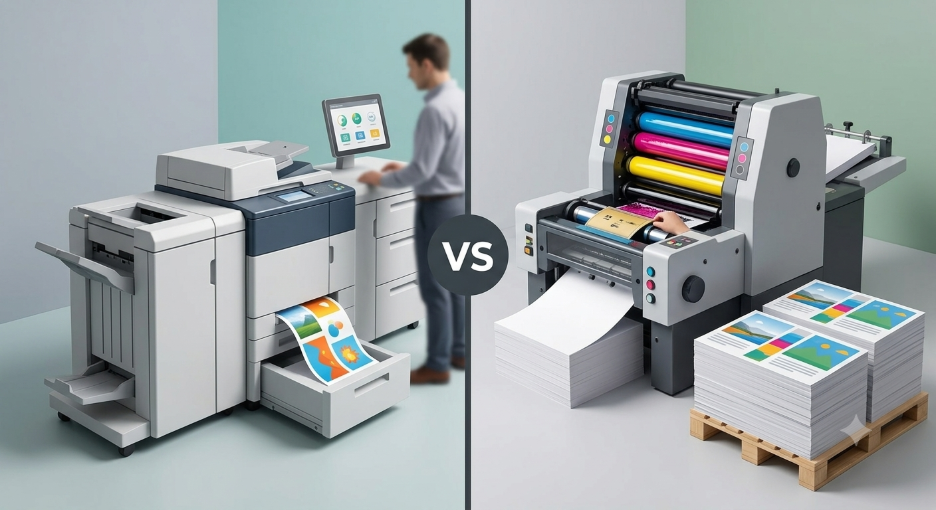
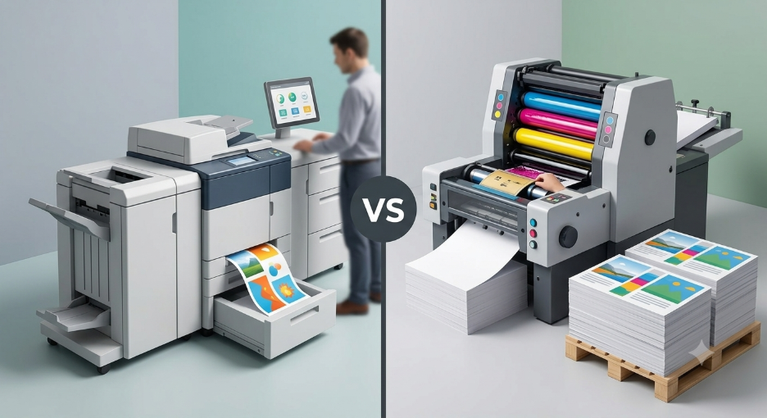
The right printing method depends on volume, personalization requirements, and timeline. Direct mail printing services use two primary production methods: digital and offset.
Digital Printing
Digital printing requires no plates, starts immediately after file approval, and supports full variable data printing, changing the name, offer, image, and QR code per recipient within a single print run. It is the right method for short runs, personalized campaigns, and time-sensitive programs. NextPage’s digital presses run variable data at up to 400 feet per minute.
Offset Printing
Offset printing uses metal plates and produces richer, more consistent color across high-volume identical runs. It is the right method for large-volume campaigns where every piece is the same. Plate setup adds production time, but the per-piece cost drops significantly at high volume, making offset more cost-efficient at higher volumes.
Finishing
Finishing options — folding, scoring, laminating, die-cutting, and tabbing or wafer sealing for self-mailers — are specified before production begins because they affect how the artwork is laid out on the sheet. Folded self-mailers must be sealed with non-perforated wafer tabs or continuous glue lines to qualify for letter-rate automation pricing.
Get a Direct Mail Printing Quote from NextPage →
5. Mailing: USPS Optimization and Delivery
Production quality gets the piece printed. USPS optimization gets it delivered at the lowest possible cost.
CASS Certification and Address Standardization
CASS certification validates every mailing address against the official USPS database, corrects formatting errors, removes non-deliverable records, and appends ZIP+4 codes that qualify for deeper automation discounts. It is a prerequisite for automation pricing, not an optional upgrade.
Presorting
Presorting organizes the mail by carrier route or ZIP code before submission to USPS. The more deeply presorted a mailing, the lower the postage rate. Carrier route presorting produces the lowest available rate for qualifying pieces. Most full-service direct mail printing providers handle presorting as part of production.
Intelligent Mail Barcode
The Intelligent Mail Barcode (IMb) is required for USPS automation pricing. It must be positioned within a dedicated 4 by 2.25-inch clear zone on the address panel. Incorrect placement disqualifies the piece from automation rates regardless of every other requirement being met.
Tracking and Reporting
Post-mail reporting on deliverability, bounce rates, and direct mail response rates is what makes each campaign smarter than the last. Tracking every unique QR code and personalized URL back to a response event connects print production directly to revenue, making the ROI case for the next campaign easier to build.
6. Direct Mail Campaign at a Glance
Every direct mail campaign moves through four stages. Here is what matters at each one — and where most campaigns go wrong.
| Stage | Key Decisions | Where It Goes Wrong |
| Planning | Audience, objective, format, list preparation | No defined segment, skipping NCOA |
| Design | Size, aspect ratio, offer hierarchy, file specs | Non-machinable size, RGB files, missing bleed |
| Printing | Digital vs. offset, personalization, finishing | Wrong method for the volume, missing wafer seals |
| Mailing | CASS certification, presorting, IMb placement | Skipping presorting, incorrect IMb zone |
7. Why NextPage for Direct Mail Printing Services
NextPage is a Kansas City direct mail printing services provider that manages the full campaign chain — from format consultation and file preflight through USPS-optimized production and tracked delivery. One vendor, start to finish.
- In-house production: Design, printing, finishing, and mailing under one roof.
- USPS optimization: CASS certification, presorting, and IMb compliance on every campaign.
- Variable data capability: Personalized direct mail printing at up to 400 feet per minute.
- Omnichannel integration: Print campaigns connected to IP targeting, retargeting, and digital follow-up.
- Proven results: Ferrellgas doubled their response rate. Habitat for Humanity achieved a 270% conversion lift. ACEP saved $40,000 immediately.
Start Your Direct Mail Campaign with NextPage →
8. Frequently Asked Questions
What is direct mail printing?
It is the production of personalized, USPS-compliant mail pieces — postcards, self-mailers, letter packages, and dimensional mail — built to reach a specific audience and drive a measurable response.
What response rates can I expect from direct mail campaigns?
The Data and Marketing Association reports direct mail response rates of around 5-9% for house lists. Personalized campaigns and omnichannel integration tend to push those figures higher.
What is the difference between digital and offset direct mail printing?
Digital requires no plates, starts production immediately, and supports unique personalization per piece. Offset uses metal plates and produces richer, more consistent color across high-volume runs where every piece is identical. The right choice depends on your volume and whether personalization is needed.
How do I qualify my direct mail campaign for USPS automation pricing?
Four things: CASS-certified addresses, correct aspect ratio, Intelligent Mail Barcode in the right position on the address panel, and presorting by carrier route or ZIP code. Miss any one of them and the piece may not qualify.
What direct mail printing services does NextPage offer?
NextPage handles the full chain — format consultation, file preflight, digital and offset printing, variable data personalization, CASS certification, presorting, USPS-compliant finishing, tracked delivery, and post-campaign reporting.