Key Takeaways
- Direct mail printing campaigns typically run between $600 and $4,500, but that number means nothing without knowing your volume, format, and finishing choices.
- Volume is the single biggest lever. Print more and your per-piece cost drops significantly with bulk mail printing discounts.
- Size and weight affect both print cost and postage. Every choice compounds.
- Personalized direct mail costs more per piece and gets responded to more. The cost per response is usually lower than a generic campaign.
- Design and tracking are real budget lines. Leave them out of the estimate and the estimate is wrong.
Table of Contents
How much does direct mail printing cost? It is the first question every marketer asks and the hardest one to answer without more information.
The honest answer is: it depends on what you choose at each stage of production. This guide breaks down every cost factor clearly so you can build a real budget before you start.
1. Key Factors That Affect Direct Mail Printing Costs
Every direct mail printing campaign involves the same core cost variables. Here is what drives the final number:
| Cost Factor | What It Affects |
| Volume | More pieces means lower cost per piece |
| Size and format | Larger pieces cost more to print and to mail |
| Finishing | Coatings, lamination, and die-cuts add cost and weight |
| Design | Affects upfront cost and campaign performance |
| Personalization | Variable data printing costs more but lifts response rates |
| Integration and tracking | CRM, triggers, and analytics add to total budget |
2. Volume, Size, and Finishing: The Three Biggest Cost Drivers
Volume
Postage is often the largest single line item in a direct mail printing budget. The more pieces you send, the lower your per-piece postage rate.
Bulk mail printing discounts from USPS kick in at higher quantities and can meaningfully reduce total campaign cost. A real example: 200 catalogs at 5.5×8.5 inches cost around $2 per piece. The same piece at 500 copies drops to around $0.60 per piece. Same design, same format, just more of them. Print at volume when the campaign supports it.
Size and Format
Typical per-piece printing costs run from around $0.05 to $2.00 depending on size, paper stock, and quantity. The smaller the piece, the lower the cost on both the print and postage side.
Postcards and self-mailers are the most cost-efficient formats. Larger pieces: letter packages, catalogs, foldout mailers, cost more on both ends. If budget is tight, start with a smaller format, test response, and scale what works.
For personalized direct mail campaigns, format also affects how much personalization is practical. A postcard gives you limited room. A self-mailer or letter package lets you vary the message, the offer, and the imagery per recipient in a meaningful way.
Finishing
Finishing options: lamination, embossing, die-cutting, UV coating, foil stamping, add a premium look and add to the cost. The part most people miss is the postage impact.
Heavier coating on heavier stock adds weight to the piece. USPS charges by weight. A finishing choice that adds a few cents per piece in production can add more in postage. At 10,000 pieces, that compounds quickly. Before committing to a finish, calculate both sides of the cost: production and postage.
Get a Direct Mail Printing Quote from NextPage →
3. How Much Does Direct Mail Marketing Actually Cost?
Here is what a typical direct mail printing services campaign costs at different scales:
| Campaign Size | Estimated Print Production* | Estimated Total Budget (Print + Postage) | Notes |
| Small (< 1,000 pieces) | $600 – $1,200 | $1,100 – $1,800 | Postcards or simple self-mailers, standard stock |
| Mid-size (1,000 – 5,000 pieces) | $1,200 – $2,500 | $2,200 – $4,500 | Includes variable data personalization and CASS address prep |
| Large (5,000 – 25,000+ pieces) | $2,500 – $6,000+ | $5,000 – $15,000+ | High-speed digital or offset; USPS automation discounts applied |
These are ranges, not quotes. Your actual cost depends on the format you choose, the finishing options, whether you are adding variable data personalization, and whether the campaign includes CRM integration and tracking.
Postage is its own line item. For standard letter-rate mail, USPS First Class runs higher than Marketing Mail. Presorting and CASS-certified address lists qualify campaigns for lower automation rates. A well-managed mailing list and a presorted job will always cost less per piece than one that skips those steps.
Talk to NextPage About Your Direct Mail Budget →
4. Additional Cost Factors: Design, Integration, and Tracking
Design
Design is easy to underestimate and impossible to ignore. It is also one of the factors that most directly determines whether the direct mail printing campaign works.
Three options:
- In-house design: No direct cost if you have a capable designer on staff. The risk is quality, a weak design wastes the print and postage spend behind it.
- Templates: Affordable, typically $5 to $10. Works for simple pieces. Not the right choice if the piece needs to stand out.
- Professional design: Highest upfront cost. Also the most likely to produce a piece worth mailing.
Whatever you choose, put the design cost in the budget before you finalize the estimate. A budget that leaves out design is not a real budget.
Integration and Tracking
Connecting a direct mail printing services campaign to a CRM or marketing automation platform costs money. It covers the tools that build the list, set up behavioral triggers, and automate future sends. It is not the biggest line item, but it is not zero either.
Tracking is the same story. QR codes, PURLs, and web analytics are what tell you whether the campaign worked. For personalized direct mail especially, tracking is what connects print spend to measurable revenue. Without it, you cannot calculate ROI and you cannot improve the next campaign.
These are not where campaigns overspend. They are where campaigns forget to budget at all.
5. Why NextPage for Direct Mail Printing Services
NextPage runs direct mail printing services campaigns end to end in Kansas City: design, printing, finishing, and mailing under one roof with no vendor handoffs and no invoice surprises.
- Full-service production: Design, printing, finishing, and mailing in-house.
- Bulk mail printing: USPS presorting, CASS certification, and volume pricing on every campaign.
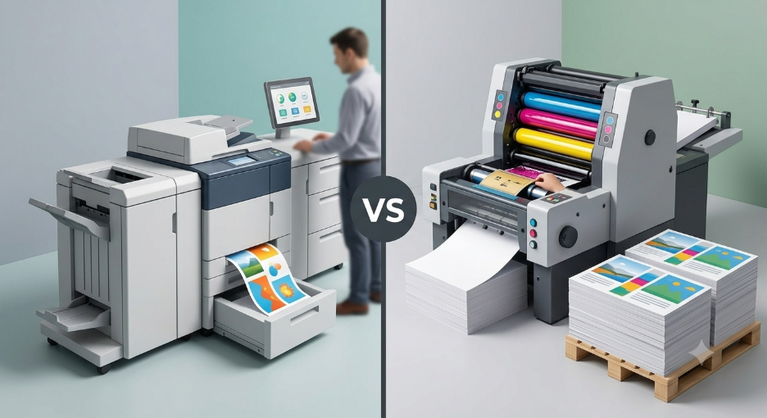
- Personalized direct mail: Variable data printing at up to 400 feet per minute.
- CRM integration: Direct connection to your marketing automation platform.
- Transparent pricing: Every cost factor confirmed before production begins.
Request a Direct Mail Printing Quote from NextPage →
6. Frequently Asked Questions
How much does direct mail printing cost?
Between $600 and $4,500 for most direct mail printing campaigns. The number depends on volume, format, finishing, design, and whether you are adding personalization or tracking. The only accurate number comes from a quote based on your actual specs.
What is bulk mail printing and how does it reduce costs?
Bulk mail printing qualifies for USPS Marketing Mail rates, which are lower than First Class. The more pieces you mail and the more thoroughly presorted the list, the lower the per-piece postage rate. At scale, this difference is significant.
Does personalized direct mail cost more than generic mail?
Yes, per piece. Personalized direct mail requires variable data setup and data processing. It also gets responded to more often. In most cases, the cost per response is lower than a generic campaign that most recipients ignore.
What direct mail printing services does NextPage offer?
Direct mail printing services at NextPage cover design, data processing, offset and digital printing, variable data personalization, finishing, USPS optimization, mailing, and post-campaign tracking: all in-house in Kansas City.
What is the cheapest direct mail format?
Postcards. Smaller, lighter, no envelope required, and they qualify for the lowest available postage rates. For a first campaign or a tight budget, start with a postcard, measure the response, and scale from there.