
Event signage failures are rarely about the design.
The artwork looks perfect on screen. The colors are approved. And then something goes wrong between file submission and installation day — the wrong substrate, a size that does not fit the venue, graphics that arrive without mounting hardware, or a print run that misses the setup window entirely.
Large format printing for events has more variables than any other print category. Material selection, file preparation, finishing, logistics, and installation coordination all have to land correctly — in sequence, on time, at the right scale. When one step breaks, the entire event presence breaks with it.
The most common large format printing failure at events is not print quality. It is timeline management. Artwork submitted too late, substrate decisions made too early, and installation coordination left too long — these are what send event teams scrambling on setup day.
Table of Contents
1. What Is Large Format Printing for Events?
2. The Complete Checklist: From Order to Installation
3. Choosing the Right Material for Your Event Environment
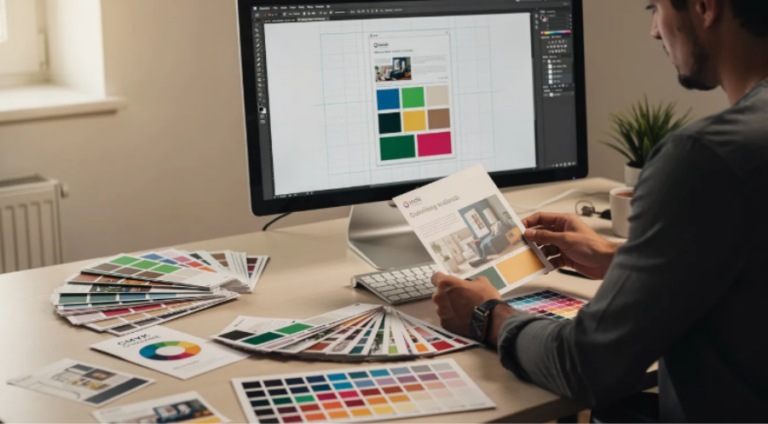
4. File Preparation: What Large Format Printing Requires
5. Finishing, Hardware, and Installation
6. Real-World Application: Nelson-Atkins Museum of Art
7. How NextPage Delivers Large Format Printing for Events in Kansas City
1. What Is Large Format Printing for Events?

The creation of larger graphics, usually anything bigger than 24 inches, for large-scale visual communication is known as large format printing. Banners, backdrops, trade show displays, floor graphics, window installations, directional signage, and environmental graphics that define a location rather than adorn it are examples of this for events.
Large format printing for events differs from normal printing in ways other than size. The production chain is what it is. Event graphics necessitate choosing a substrate based on venue requirements, matching finishing options to installation techniques, organizing logistics according to setup schedules, and frequently coordinating on-site installation. It is possible to mail a poster in a tube. An event backdrop of 20 feet can’t.
Large format printing for events is a production discipline, not just a print order. The organizations that get it right treat substrate selection, file prep, finishing, and installation as one connected workflow — not four separate decisions.
99%
On-time delivery rate for NextPage large format and event printing orders
40%
Faster event setup time for clients using NextPage’s pre-packed signage kits
100+
Major event partners supported annually by NextPage’s large format production team
Get a Large Format Printing Quote from NextPage →
2. The Complete Checklist: From Order to Installation
Every step of an event display printing project is covered by this checklist, along with the order in which choices must be made. The most dependable method of preventing timeline issues is to work backwards from installation day.
- 6 weeks out — Measure all display areas, confirm substrate needs, check venue restrictions, and brief your design team on production specs
- 4 weeks out — Submit print-ready artwork, approve materials and finishing choices, and sign off on proofs at full scale
- 2 weeks out — Confirm delivery dates with a buffer, finalize installation logistics, and request mounting schematics from your print supplier
- Day of installation— Inspect every item against the order manifest before installation begins, follow substrate-specific installation instructions, and photograph finished displays for documentation
Want the full step-by-step breakdown? Download the complete checklist as a PDF and keep it handy for your next event → [Download Now]
Request an Event Printing Consultation from NextPage →
3. Choosing the Right Material for Your Event Environment
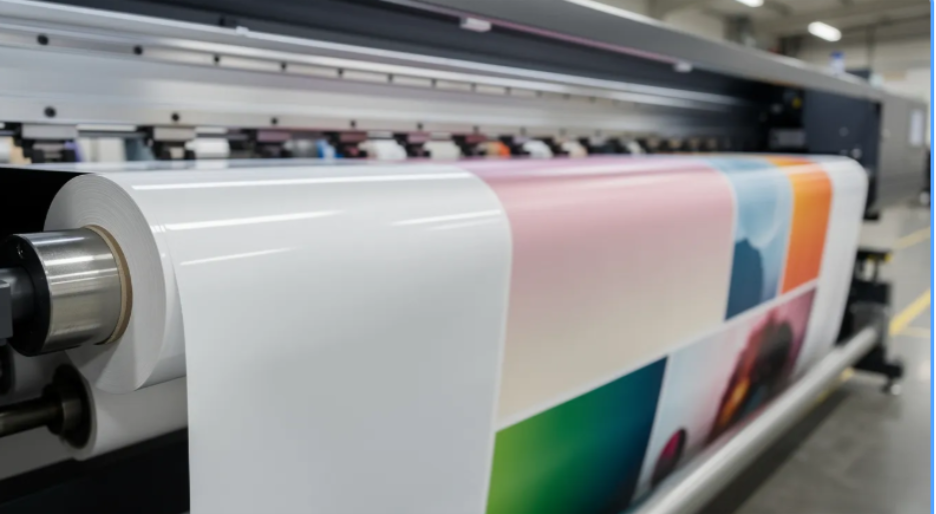
Material selection is the most consequential decision in large format printing for events — and the one most often made too late. The substrate determines installation method, finishing options, weight, packability, and durability. Choosing the wrong material for the environment means reprinting, not adjusting.
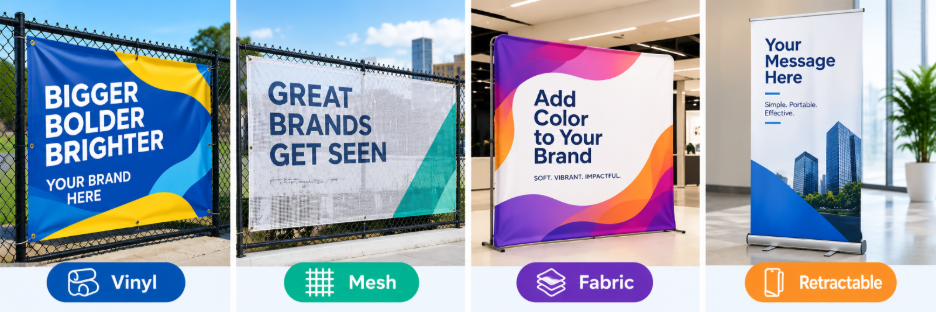
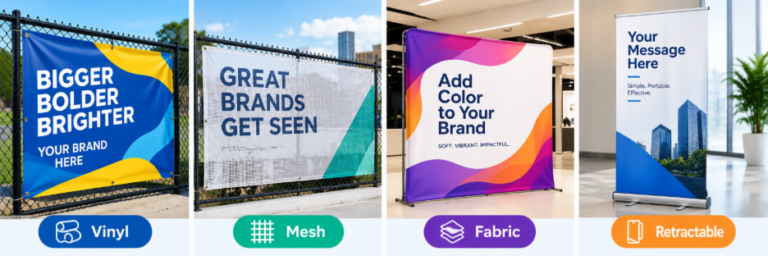
| Material | Best Environment | Common Event Applications |
| Vinyl | Indoor and outdoor | Banners, floor graphics, window graphics, vehicle wraps |
| Perforated Window Film | Glass surfaces, building facades | Window graphics, building installations, exhibit promotion |
| Fabric | Indoor, trade show, backlit displays | Backdrops, retractable banners, trade show displays |
| Mesh | Outdoor, high-wind environments | Building wraps, outdoor banners, fence signage |
| Rigid Board / PVC | Indoor, short-term | Directional signage, tabletop displays, POP displays |
| Foam Board | Indoor, lightweight applications | Event signage, directional signage, display panels |
For outdoor applications, UV-resistant inks and weatherproof substrates are not optional — they are the baseline. Indoor banner printing for events allows more substrate flexibility, but ventilation, lighting, and surface conditions still affect material performance. A fabric backdrop that performs well under standard indoor lighting may read differently under event spot lighting.
4. File Preparation: What Large Format Printing Requires
File preparation failures account for a significant share of large format printing delays and reprints. The requirements for large format differ from standard commercial printing — and submitting a file built to standard print specs will produce avoidable problems at scale.
What every large format print file needs:
- Resolution — 100–150 DPI at full output size. Files submitted at 72 DPI screen resolution will print with visible pixelation at large format scale. However, it is important to note that the resolution requirements depend heavily on the viewing distance of the asset.
- Color mode — CMYK, not RGB. RGB files are converted at the RIP stage, and color shifts during conversion can be significant — especially in brand-critical colors.
- Bleed — Minimum 0.5 inches on all edges. For large format banner printing for events, larger bleeds may be required depending on finishing method.
- Safe zone — Keep critical content — text, logos, key imagery — at least 1 inch from the edge. Finishing processes like hemming and grommet placement affect the outermost edge of the print.
- Embedded fonts and linked files — All fonts must be outlined or embedded. Linked files that are not packaged with the submission will cause production delays.
- Vectorized Tracking Elements — If your graphics utilize QR codes or digital triggers to capture intent data, ensure these elements are high-resolution vector assets. A pixelated QR code blown up to a 10-foot scale will fail to scan, breaking the bridge between your physical event presence and your digital marketing stack.
The single most common large format file error is submitting artwork built at a reduced scale — for example, at 10% of output size at 1500 DPI — without confirming the scaling calculation with the print provider. What appears high-resolution in the file can be significantly lower resolution at true output size.
5. Finishing, Hardware, and Installation
Finishing is what makes large format printing functional at an event, not just visual. The finishing method determines how a piece is installed, how long it lasts, and whether it can be reused.
Finishing Options
- Lamination — Gloss lamination increases color vibrancy and scratch resistance. Matte lamination reduces glare, which matters for graphics in high-light environments. Anti-scratch lamination is recommended for floor graphics and any surface subject to contact.
- Grommets — Metal reinforced holes for hanging banners. Standard spacing is every 2 feet along the top edge, with corner grommets. Heavy banners require more frequent grommet placement.
- Hemming — A welded or sewn border that reinforces the edges of vinyl banners, preventing tearing at stress points. Essential for outdoor event banner printing where wind load is a factor.
- Pole pockets — Sewn channels along the top and/or bottom edge for horizontal poles. Used for retractable banners, tension fabric displays, and banners hung in frame systems.
- Mounting hardware — Rigid panels, foam boards, and PVC signage require mounting hardware matched to the installation surface. NextPage provides mounting templates and hardware specifications for on-site installation teams.
Installation Support
NextPage provides installation support ranging from mounting hardware and templates to full on-site coordination for complex event display printing installations. For straightforward banner and signage installations, hardware kits and installation documentation are provided with the order. For complex installations — building facades, multi-panel environments, or precision-aligned graphic systems — on-site coordination is available.
Talk to NextPage About Your Event Display Printing Needs →
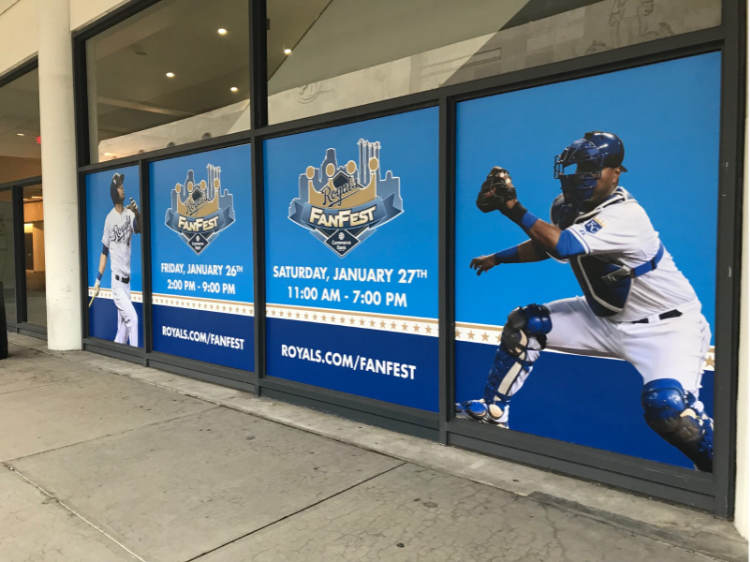
6. Real-World Application: Nelson-Atkins Museum of Art
When the Nelson-Atkins Museum of Art in Kansas City needed to promote a Picasso exhibit, the challenge was not just producing a large graphic — it was producing the right graphic for a technically demanding installation environment.
The museum façade featured tinted glass, which eliminated standard perforated window film as an option. Standard 60/40 and 70/30 perforated films do not adhere or perform correctly against tinted surfaces and compromise interior visibility and natural light.
NextPage engineered a solution using 80/20 perforated window film — a specification that maintained the visual impact of the exhibit promotion on the building exterior while preserving sightlines and light transmission from inside the museum. The installation covered the building façade prominently, drew public attention to the exhibit, and received positive response from both museum staff and visitors.
The Nelson-Atkins project illustrates what separates a capable large format printing partner from a standard print vendor. The difference was not equipment — it was the ability to diagnose a substrate compatibility issue before production began and specify the right material for the installation environment.
For more NextPage case studies, visit gonextpage.com/case-studies.
7. How NextPage Delivers Large Format Printing for Events in Kansas City
NextPage is a Kansas City commercial printing and large format production company serving event teams, marketing agencies, cultural institutions, trade show exhibitors, and enterprise marketing departments — regionally and nationally.
Their large format printing capabilities cover the full production chain — from file review and material selection through printing, finishing, and installation support. Production uses UV, solvent, and dye-sublimation printing processes matched to substrate and application requirements, with color-accurate output at any scale.
What NextPage provides for event large format projects:
- Design and file review — In-house creative support and file preflight to catch resolution, color mode, and scaling issues before production begins.
- Material selection guidance — Substrate recommendations based on venue environment, installation method, and reuse requirements.
- Full finishing capabilities — Lamination, grommets, hemming, pole pockets, and mounting hardware matched to the installation plan.
- Pre-packed signage kits — Event graphics organized and labeled by location for 40% faster setup time on installation day.
- Installation support — Mounting templates and hardware documentation provided with every order. On-site coordination available for complex installations.
- 99% on-time delivery — Production and logistics built around event deadlines, with the ability to handle high-volume output under tight timelines.
For organizations across Kansas City evaluating large format printing for events — or event teams anywhere that need a production partner who understands the difference between a print order and an event installation — NextPage manages the full process from file submission through setup day.
Request a Large Format Printing Quote from NextPage →
8. Frequently Asked Questions
What is large format printing for events?
Large format printing for events is the production of oversized graphics — banners, backdrops, trade show displays, floor graphics, window installations, and environmental signage — used to define and brand event spaces. It differs from standard commercial printing in substrate selection, finishing requirements, logistics, and installation coordination.
What file format and resolution does large format printing require?
Large format printing requires files submitted at 100–150 DPI at full output size, in CMYK color mode, with a minimum 0.5-inch bleed. RGB files, low-resolution artwork, and missing fonts or linked files are the most common causes of production delays and reprints.
What materials are used for event banner printing?
Banner printing for events uses vinyl as the primary substrate for indoor and outdoor banners, with fabric for trade show and backlit displays, mesh for high-wind outdoor environments, and perforated film for window and glass surface installations. Material selection depends on the installation environment, venue restrictions, and whether the piece needs to be reused.
How far in advance should I order large format printing for an event?
For event display printing, artwork should be submitted at least four weeks before the event, with final delivery targeted two weeks before installation day. This allows time for proofing, any reprints, and installation coordination. Complex installations — building graphics, multi-panel systems, or custom substrates — require additional lead time.
Does NextPage provide installation support for large format event graphics?
Yes. NextPage provides installation support for large format printing projects ranging from mounting hardware and installation documentation to full on-site coordination for complex installations. Every order includes mounting templates and hardware specifications. For installations requiring on-site expertise — such as building façade graphics or precision-aligned multi-panel systems — on-site coordination is available.
What makes NextPage different for large format event printing?
NextPage’s large format printing capabilities include in-house design support, substrate engineering for complex installation environments, pre-packed signage kits that reduce event setup time by 40%, a 99% on-time delivery rate, and installation support from hardware provision through on-site coordination. Their work for the Nelson-Atkins Museum of Art — using custom 80/20 perforated window film for a tinted-glass facade — demonstrates the level of technical problem-solving they bring to complex large format projects.