With practically every print project, the issue comes up: offset or digital?
That sounds like a technical decision. And it is — but not in the sense most people think it is. The right answer isn’t which method is best. It’s about what method is suitable for this job, this volume, this timeframe, and this budget.
If you get it wrong, you burn budget. Short-run offset printing can increase the cost per piece because setup costs are spread across fewer pieces. For high-volume, brand-critical work, digital printing can be effective but offset is often preferred when maximum color consistency is required. That choice makes a big difference — it is one of the first decisions that determines any commercial printing project.
It’s not a matter of preference whether to go offset or digital. That’s a production decision. Volume, schedule, color criticality and personalization requirements all point to one approach or the other – and experienced print partners know which way to go before the work brief is finalized.
Table of Contents
3. Offset vs. Digital: Side-by-Side Comparison
4. When to Choose Offset Printing
5. When to Choose Digital Printing
6. What About Variable Data and Direct Mail?
7. How NextPage Helps You Choose the Right Commercial Printing Method
1. What Is Offset Printing?
Offset printing is a commercial printing method in which ink is transferred from a metal plate to a rubber blanket and then to the printing surface. It is called offset because the inked image is not transferred directly from the plate to the substrate. The result is fine detail, rich color density, and consistent reproduction across every copy in the run.
In offset printing you have to set up plates – one for each color – before you can run the job. The set-up cost is fixed, no matter what the run size, therefore offset gets more cost effective the higher the volume. The cost per item drops dramatically below what digital can achieve at huge volumes.
For brand-critical products — catalogs, brochures, high-end marketing collateral — where color accuracy and consistency are non-negotiable, the offset printing advantages are clear: no process offers richer color or better detail at scale.
2. What Is Digital Printing?
Digital printing runs files directly from the computer to the press – no plates, no make-ready, no fixed beginning costs. Each item is printed separately, thus each copy in the edition is unique. It’s the manufacturing process for customized direct mail, on-demand printing and short-run commercial printing services where speed and flexibility trump volume efficiency.
Digital printing is easier to start without plate set up and less expensive with modest numbers. Artwork can be altered without scraping a plate. And because each piece is made one at a time, variable data—different names, offers, photographs and QR codes for each recipient—is incorporated into the production process instead of being placed on top.
NextPage’s digital presses can accommodate variable data printing at speeds up to 400 feet per minute — taking large-scale customizable commercial printing from a trade-off to a production reality.
Talk to NextPage About the Right Printing Method for Your Job →
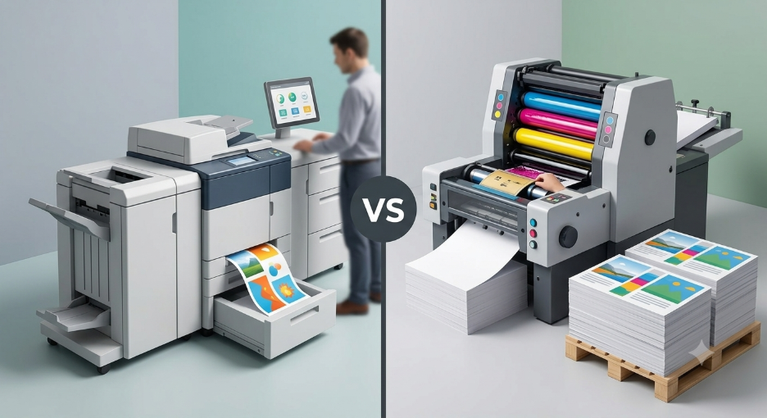
3. Offset vs. Digital: Side-by-Side Comparison

Five factors that directly impact offset printing vs digital printing are volume, cost structure, speed, color and personalization. Here is the side-by-side comparison:
| Factor | Offset Printing | Digital Printing |
| Best Volume | High (1,000+ pieces) | Low to medium (under 1,000 pieces) |
| Cost Structure | Fixed setup + low per-piece cost at scale | No setup cost (consistent per-piece cost) |
| Turnaround | Longer (plate setup required) | Fast (production starts immediately) |
| Color Quality | Rich, consistent, Pantone-accurate | Strong- best for short-to-mid runs |
| Personalization | Not supported (identical copies) | Full variable data per piece |
| Best For | Catalogs, brochures, high-volume collateral | Short runs, direct mail, on-demand, personalized campaigns |
There is no one right way. The 50,000-piece catalog run is for an offset press. Digital press puts on a 500-piece tailored direct mail campaign. The job dictates the method, not the other way around.
4. When to Choose Offset Printing
If the volume is high, color consistency is crucial and the content will not vary between copies, then offset printing is the best solution.
High volume runs: Catalogs, annual reports, brochures and marketing collateral produced in quantities of 1,000 or more. The run cost amortizes the setup cost, and the per-piece cost decreases as the quantity increases.
Brand-critical color: Offset printing uses Pantone color matching to ensure that every copy in the run is a consistent, rich color. For items whose brand color accuracy is non-negotiable, offset is the standard of production.
Premium Paper Stocks: Offset printing has a broader selection of substrates and paper weights than digital making it the perfect choice for high end finishes, specialist stocks and pieces that rely on tactile quality.
Long Shelf Life: Collateral in circulation for months Product catalogs, brand guides, event programs Benefits from the durability and color stability of offset production
5. When to Choose Digital Printing
When speed, flexibility or personalization is the driver for the project, digital printing is the correct solution.
Short Runs: For quantities under 1,000, digital is free of the plate setup expense that makes offset expensive at low volume. On-demand printing. Test runs. Regional variances. All of these belong on a digital press.
Fast turnaround: When the timeline is tight, digital starts immediately. No plate fabrication, no setup approval cycle — the file goes to press and production starts.
Personalized content: Digital production is necessary for any project where individual items need to be different – names, offers, photographs, or QR codes. Variable data printing is a digital native capability.
Testing and versioning: testing creative, running regional offer variants or creating numerous copies of a piece for distinct audience groups is economical on a digital press and impractical on offset.
6. What About Variable Data and Direct Mail?
Variable data printing and personalized direct mail are always digital. Since offset printing is designed to make identical copies, there is no offset equivalent for varying content from piece to piece.
Digital is the sole manufacturing option for commercial printing services that require both large volume and personalization – such as a 50,000-piece direct mail campaign where each one has a different name, offer and QR code. NextPage’s digital presses can run up to 400 feet per minute for changeable data output, enabling big customizable runs to be operationally viable without sacrificing turnaround time.
Some campaigns employ both: offset for a high-volume static piece, an outer envelope or supporting insert, and digital for the individualized inner piece. Knowing when to split production between processes is part of what a good commercial printing partner provides to a project.
Request a Commercial Printing Quote from NextPage →
7. How NextPage Helps You Choose the Right Commercial Printing Method
NextPage is a commercial printing and direct mail marketing company based in Kansas City. Our in-house expertise includes:
- High volume, color critical runs using offset printing
- Digital printing for short batches, quick turnaround and on demand production
- Variable data printing @ 400 ft./min. for customized campaigns
- Finishing and bindery to suit the technique of manufacture
- End to end help from project planning to delivery
NextPage helps Kansas City firms considering commercial printing services, or marketing teams making a production decision, to identify the right approach before the brief is finished.
Talk to NextPage’s Commercial Printing Team →
8. Frequently Asked Questions
What is the difference between offset printing and digital printing?
Digital printing or offset printing? It’s all about volume, cost structure, and customization. It is economical at huge quantities and offers excellent color accuracy. Offset employs metal plates to make multiple copies of high quality on a large scale. Digital printing does not use plates, has a quicker start-up time, is cheaper at low numbers, and permits flexible data customization. The correct strategy relies on the job requirements.
When should I use offset printing for commercial printing?
Offset printing advantages are most obvious when printing high-volume runs of 1,000 pieces or more, brand-critical color work requiring Pantone matching, premium paper stocks, and long-shelf-life collateral such as catalogs and annual reports. Offset is the manufacturing standard when thousands of identical copies need to be consistent.
When is digital printing the better commercial printing method?
If you need small runs of less than 1,000 pieces, fast-turnaround jobs, individualized direct mail with variable data, A/B testing and regional versioning, then digital printing is the correct commercial printing method for you. It removes the plate setup costs and starts right away — making it the most efficient option when speed or flexibility is the key.
Can offset and digital printing be used together in one campaign?
Yes. Many commercial printing campaigns split production between the two processes – offset for a high-volume static component and digital for a tailored inner piece or variable insert. NextPage takes care of the split production workflow so marketers don’t have to coordinate with vendors.
What commercial printing services does NextPage offer in Kansas City?
NextPage’s commercial printing services in Kansas City include offset printing, digital printing, variable data printing, direct mail, large-format printing, and finishing and bindery. All services are managed in-house, with state-of-the-art equipment, eco-friendly production, and end-to-end support from project planning through delivery.